the 42 curriculum
At 42 Berlin, future software engineers gain both technical expertise and essential soft skills through a peer-to-peer, project-based learning method.
Following the Piscine, you will advance through the Common Core, evolving from foundational coding to Master’s-level specialization. You control your trajectory by selecting the projects that interest you, ensuring your path is unique to your career goals.
We replace traditional grades with Experience Points (XP), turning failure into a constructive part of the debugging process.
This 4-stage journey is designed to ground you in essential logic before launching you into expert-level fields.
YOUR 42 JOURNEY
A flexible journey from zero knowledge to industry expert.
The Piscine
Your journey begins with a 4-week deep dive. This immersive selection process tests your potential, not your past grades. You will solve coding challenges in C and Shell, learning to collaborate with peers in a high-intensity environment.
Core Curriculum
This is your computer science foundation. You will complete 27 hands-on projects spanning 7 thematic modules. You will master C Programming (Libft, printf) before advancing to C++ (Object Oriented), Networks, and Docker.
Internship
Transition from learner to professional. After completing the Core, you are encouraged to take a 4–6 month internship. This real-world experience validates your skills and prepares you for the advanced specialization phase.
Specialization
Unlock the Advanced Curriculum. You design your own path in fields like Cybersecurity, AI, Kernel, or 3D Graphics. Your goal is to reach Level 21, achieving a qualification equivalent to a Master’s degree.
CORE CURRICULUM
12–18 months
This is your foundation. You will master the fundamentals of C, explore the versatility of Python, and dive into full-stack web development and AI. You will build a comprehensive understanding of systems, networks, algorithms, and object-oriented design. This competency-based progression means you advance only when you demonstrate mastery.
The core curriculum takes an average of 18 months of full-time study to complete, however this varies depending on how much time one dedicates to it. The maximum amount of time that can be spent on the curriculum is 24 months. 42 accommodates flexibility in schedule and pace, however we strongly recommend prioritising your studies over other activities while you’re here, as a certain amount of momentum is needed to progress well.
WORK EXPERIENCE 1
4–6 months
Once you finish the core part of the curriculum, you will get the chance to put all your newfound knowledge and skills into professional practice.
Our strong partner network, extracurricular learning events to support with job application material preparation in addition to ongoing peer-led formats provide a solid foundation to support you as you navigate your internship and job search.
Many of our students go on to complete internships at our partner companies, including Microsoft, VW, CARIAD, Capgemini, T-Systems, SAP, and Bayer. However, no student is under any obligation to work with any partner company and many students take their first steps into the tech world through internships at other companies or startups, depending on their goals and interests.
As an essential part of your learning journey and a key first step into the professional tech world, internships must be paid, in the IT sector, and should provide an environment for hands-on learning in a tech team.
After gaining this real-world experience, it’s the perfect time to return and further specialise in your chosen field.
We’ll open doors in tech and you’ll walk through them.
SPECIALISATION
Up to 5 years
This is where things get super interesting. By specialising in a field of your choice, you will be trained up to the equivalent of masters level. Our specialisations change and update frequently, and they currently include: artificial intelligence, cybersecurity, web and mobile app development, operating systems, graphical programming, SEA:ME and more.
You will not be obligated to stick to one specialisations, or see it through the the finish line if you do not want; but rather you will be given the flexibility to choose the projects that interest you as and when they do.
When you would like to finish your studies to become an alumni is totally in your hands and it is not uncommon that students leave us earlier than expected due to the acquisition of their desired job. You will have the option to undertake this part of the program in any other 42 campus in the world.
WORK EXPERIENCE 2
The final internship is a 6 month internship that will incorporate all that has been learned thus far.
By this time, you will be extremely qualified and more than ready to work in-projects that will take your skills to the next level.
CORE CURRICULUM
12–18 months
The core curriculum aims to give each student a rich and sturdy foundation, incorporating soft and hard skills alike. You will focus on C and C++ programming, work with classic algorithm softwares, discover file systems and understand the UNIX processes. Alongside this, you will touch upon network architecture, system administration, object-oriented programming, and client-server projects.
We structure our projects like a blossoming tree. Once a project is complete, you can move to the next branch until it splits. This allows you to discover multiple aspects of coding and IT. Each student’s journey will be unique, experimenting with different projects and specialisation paths.
You’ll cover the following topics in the core curriculum: Imperative programming in C, Object-Oriented Programming in C++, Data Structures & Algorithms, Concurrent programming, Network programming, Networks and Systems administration, Graphics programming, Web programming.
WORK EXPERIENCE1
4–6 months
Once you finish the core part of the curriculum, you will get the chance to put all your newfound knowledge and skills into professional practice.
Our strong partner network, extracurricular learning events to support with job application material preparation in addition to ongoing peer-led formats provide a solid foundation to support you as you navigate your internship and job search.
Many of our students go on to complete internships at our partner companies, including Microsoft, VW, CARIAD, Capgemini, T-Systems, SAP, and Bayer. However, no student is under any obligation to work with any partner company and many students take their first steps into the tech world through internships at other companies or startups, depending on their goals and interests.
As an essential part of your learning journey and a key first step into the professional tech world, internships must be paid, in the IT sector, and should provide an environment for hands-on learning in a tech team.
After gaining this real-world experience, it’s the perfect time to return and further specialise in your chosen field.
We’ll open doors in tech and you’ll walk through them.
SPECIALISATION
Up to 5 years
This is where things get super interesting. By specialising in a field of your choice, you will be trained up to the equivalent of masters level. Our specialisations change and update frequently, and they currently include: artificial intelligence, cybersecurity, web and mobile app development, operating systems, graphical programming, SEA:ME and more.
You will not be obligated to stick to one specialisations, or see it through the the finish line if you do not want; but rather you will be given the flexibility to choose the projects that interest you as and when they do.
When you would like to finish your studies to become an alumni is totally in your hands and it is not uncommon that students leave us earlier than expected due to the acquisition of their desired job. You will have the option to undertake this part of the program in any other 42 campus in the world.
WORK EXPERIENCE 2
The final internship is a 6 month internship that will incorporate all that has been learned thus far.
By this time, you will be extremely qualified and more than ready to work in-projects that will take your skills to the next level.
WHAT YOU WILL LEARN
C Foundations & Libft
Build your own C library from scratch. Re-code standard functions (`libc`) to understand memory management, variable types, and low-level data structures like Linked Lists.
System & Virtualization
Dive into the UNIX ecosystem. Set up a secure Linux server, master Bash scripting, and configure virtualization to understand the OS layer beneath your code.
Graphics & Algorithms
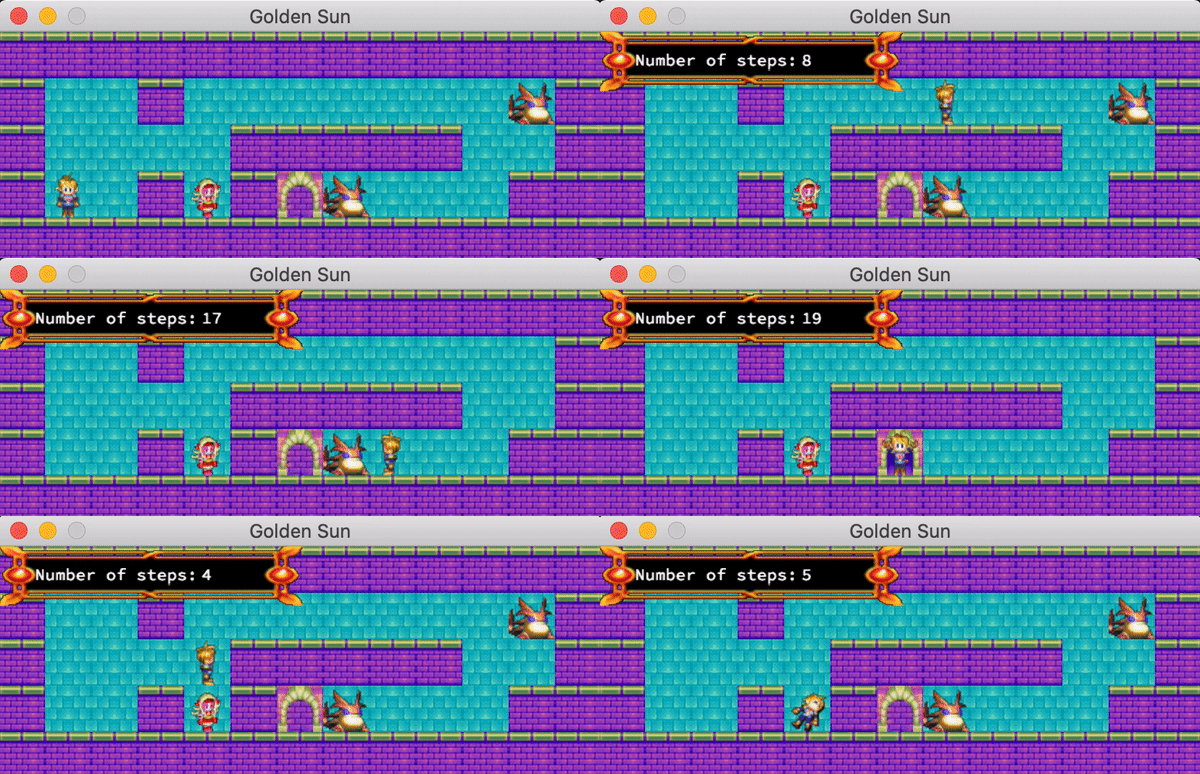
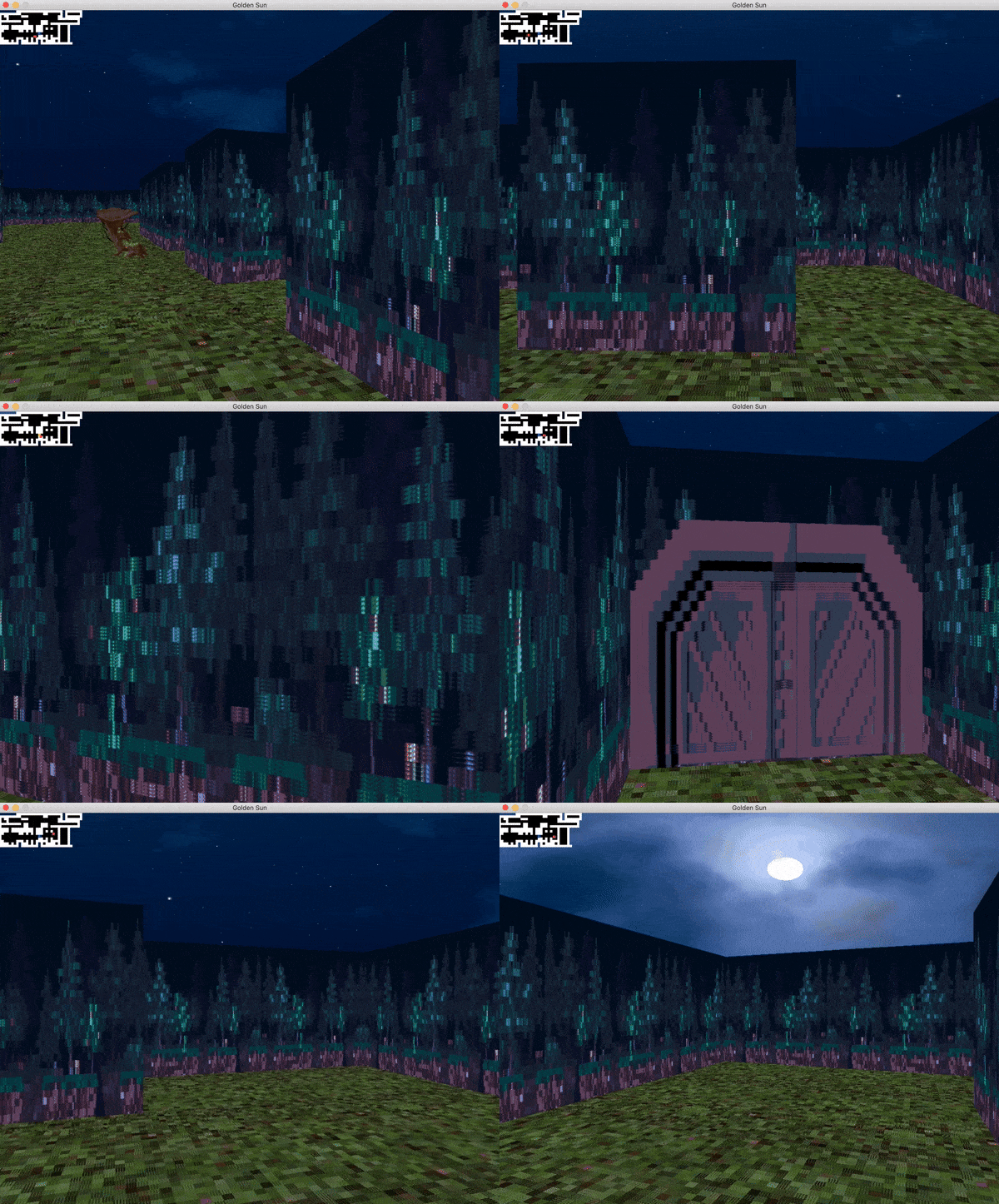
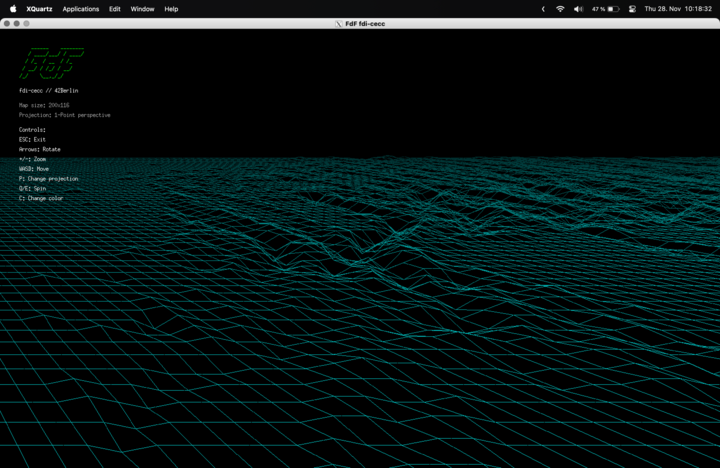
Visual creativity meets logic. Build 2D graphical projects (fractals or games) and implement highly optimized sorting algorithms to manipulate data stacks efficiently.
Shell & Concurrency
Deepen your system knowledge by building your own Shell (Minishell). Learn to manage processes, pipes, and solve concurrency problems (The Dining Philosophers) using threads and mutexes.
C++ & Raytracing
Transition to Object-Oriented Programming. Master C++ (Classes, Templates, Containers) and apply physics/math logic to build a 3D Raytracer from scratch.
Network Services
Understand the web from the inside out. Code your own fully functional HTTP Web Server and an IRC Chat Server using C++ sockets and multiplexing (poll/epoll).
Transcendence (Final)
The final Core boss. Build a complete Single Page Application (SPA) featuring a real-time multiplayer game (Pong). Integrate a backend (NestJS/Django), database (Postgres), and Docker.
THE 42 LEARNING MODEL
Peer-to-Peer
No teachers. You learn by explaining code to your peers and defending your projects in rigorous evaluations.
Project-Based
100% Hands-on. You solve over 200 software challenges, from creating libraries to coding 3D engines.
Mastery Learning
Advance only when you understand. There are no deadlines for specific modules, allowing you to learn at your own pace.
Gamified
Earn experience points (XP). You start at Level 0 and progress to Level 21, unlocking achievements and badges.
Technical Mastery
-
Unix & Infrastructure System Administration, Docker, Virtualization, and Bash Scripting.
-
C++ & Graphics Object-Oriented Programming (OOP), 3D Raytracing, and Game Engines.
-
Algorithmic Engineering Deep C mastery, Complexity Analysis, Sorting Algorithms, and Pointers.
-
Network Architecture TCP/IP, Sockets, HTTP Protocol Implementation, and IRC Servers.
Professional DNA
-
Autonomous Learning The ability to filter information and learn any new technology without guidance.
-
Collaboration Leading group projects, Git workflow, and providing constructive peer reviews.
-
Critical Thinking Questioning sources and creating new hypotheses to solve unknown problems.
-
Resilience Adapting to failure through a "try and fail" experimental mindset.
Projects
All projects are written in C programming language

‘Fract-ol’ Project
A simple programm to calculate and draw fractals
Student: Alexandra Roux